
Self Cleaning Filtration Systems vs. Traditional Filtration: Key Differences for Industrial Applications
Explore the main differences between self cleaning filtration systems and traditional filtration methods for industrial applications. Find out which option best suits your facility’s needs.
Industrial facilities across Malaysia and globally rely on effective filtration to maintain process efficiency, product quality, and equipment longevity. Choosing the right filtration system can significantly impact operational costs, downtime, and regulatory compliance. Two major approaches dominate industrial filtration: self cleaning filtration systems and traditional filtration methods. Understanding their differences is essential for plant engineers, maintenance teams, and procurement managers seeking optimal performance and reliability.
Understanding Traditional Filtration Methods
Traditional filtration systems, such as bag filters, cartridge filters, and sand filters, have long been the backbone of industrial fluid processing. They typically involve a filtration medium housed within a vessel. As contaminated liquid passes through, suspended solids and particulates are captured on or within the filter media. Over time, these solids accumulate, causing pressure drop and reduced flow rates, requiring the filter element to be replaced or cleaned.
Common types of traditional filters include:
- Bag filter housings: Widely used in food & beverage, chemicals, and water treatment for bulk particulate removal.
- Cartridge filter housings: Ideal for finer filtration in pharmaceutical, electronics, and laboratory environments.
- Membrane filter housings: Utilized for applications needing precise particle or microbial removal.
While these systems are proven and versatile, they require manual intervention for maintenance and media replacement, which can lead to process interruptions and increased operating costs over time.
What Are Self Cleaning Filtration Systems?
Self cleaning filtration systems represent a modern advancement in industrial filtration technology. Unlike traditional filters, these systems are designed to automatically remove accumulated solids from the filter media without halting the filtration process. This is achieved through mechanical scrapers, backwashing, or suction mechanisms that dislodge debris and expel it from the system.
Key features of self cleaning filters include:
- Continuous operation: No need for frequent shutdowns to replace or clean filter elements.
- Automated maintenance: Cleaning cycles are controlled by pressure differentials or timers, reducing manual labor.
- Consistent filtration performance: The system maintains optimal flow rates and filtration efficiency over extended periods.
These systems are particularly valued in industries with high solid loads, critical process uptime requirements, or challenging operating conditions, such as petrochemical refineries, power generation plants, and palm oil processing facilities.
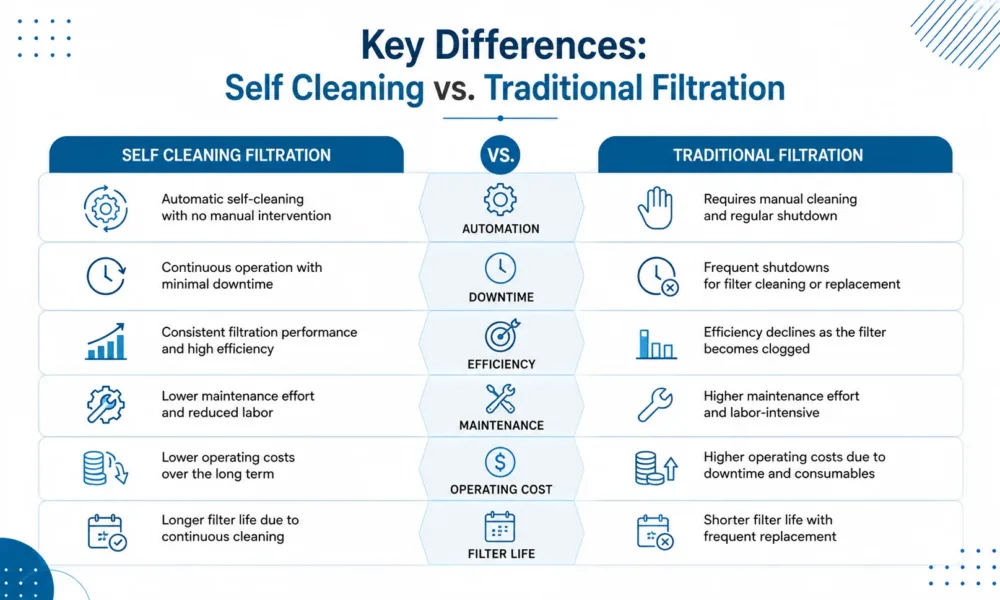
Key Differences: Self Cleaning vs. Traditional Filtration
To help decision-makers evaluate which system best fits their needs, it is important to highlight the fundamental differences between self cleaning filtration systems and traditional filtration methods:
| Criteria | Self Cleaning Filtration | Traditional Filtration |
|---|---|---|
| Maintenance | Automated, minimal manual intervention | Manual replacement or cleaning required |
| Downtime | Continuous operation, reduced downtime | Regular shutdowns for service |
| Operating Cost | Higher initial cost, but lower long-term operational expenses | Lower initial cost, but higher ongoing labor and consumable costs |
| Filtration Consistency | Stable performance over time | Performance decreases as filter loads with contaminants |
| Waste Generation | Minimal, as filters are not regularly disposed | Significant, due to frequent media replacement |
| Suitability | Best for high solids, critical uptime, automated plants | Suited for lower solids or non-continuous processes |
Advantages and Disadvantages
Advantages of Self Cleaning Filtration Systems
- Significantly reduces manual labor and operator intervention.
- Minimizes production downtime, allowing for continuous filtration.
- Delivers stable filtration quality and process consistency.
- Reduces waste generated from disposable filter media.
- Ideal for challenging or high-volume industrial applications.
Potential Drawbacks of Self Cleaning Systems
- Higher upfront investment compared to basic traditional filters.
- Requires more complex installation and integration with plant automation.
- Periodic technical checks are needed to ensure proper operation.
Advantages of Traditional Filtration Methods
- Lower initial system cost and simpler to install.
- Familiar technology for most operators and maintenance teams.
- Flexible for small to medium-scale or batch-processing operations.
Potential Drawbacks of Traditional Filtration
- Frequent maintenance shuts down the process for filter changes.
- Higher ongoing costs due to labor and consumable media.
- Greater environmental impact from filter waste.
- Filtration efficiency can vary as filters become clogged.
How to Choose the Right Filtration System for Your Facility
Selecting between self cleaning filtration systems and traditional filtration depends on a range of operational, financial, and process requirements. Here are key considerations:
- Process continuity: For plants where downtime is costly, self cleaning systems offer clear advantages.
- Contaminant load: High solid or variable contaminant loads are better managed with automated cleaning.
- Maintenance resources: Facilities with limited staff may benefit from automation and reduced manual tasks.
- Budget constraints: Traditional systems are less expensive to install but may incur higher lifecycle costs.
- Industry standards: Consider compliance and certification requirements for your industry (e.g., ISO 9001, ASME).
Consulting with a reputable self cleaning filtration system manufacturer can help you assess your specific needs and identify the most cost-effective and reliable solution for your application.
Conclusion: Making the Optimal Filtration Choice
Both self cleaning and traditional filtration systems play vital roles across Malaysia’s diverse industrial sectors, from semiconductor manufacturing to palm oil refining and water treatment. While traditional filters remain effective for many applications, the operational advantages of self cleaning filtration systems are increasingly attractive for modern, automated, and high-demand facilities.
Ultimately, the right choice depends on your site’s unique requirements, including process demands, available resources, and long-term operational goals. By understanding the key differences and consulting with experienced filtration experts, industrial companies can achieve greater efficiency, reliability, and compliance in their filtration processes.
Ready to Upgrade Your Industrial Filtration System?
Partner with Recalyx, Malaysia’s trusted self cleaning filtration system manufacturer, and unlock the benefits of advanced, reliable, and efficient filtration solutions for your facility. With 28+ years of experience, in-house R&D, and custom engineering capabilities, Recalyx supports industries from semiconductor and power generation to food & beverage, palm oil, and more. Discover our full range of filter housings, custom systems, and technical services designed to meet your toughest industrial filtration challenges.
Frequently Asked Questions
What is a self cleaning filtration system?
A self cleaning filtration system is an automated filtering solution designed to remove contaminants from liquids while simultaneously cleaning the filter media without halting the filtration process. These systems use mechanical, suction, or backwash methods to expel captured solids, providing continuous and efficient filtration for industrial use.
How does self cleaning filtration reduce downtime?
Self cleaning filtration systems automatically clean themselves using built-in mechanisms, so the filtration process continues uninterrupted. This minimizes the need for manual filter changes and system shutdowns, significantly reducing operational downtime compared to traditional filtration methods.
When should traditional filtration systems be used instead of self cleaning systems?
Traditional filtration systems are suitable for applications with low contaminant loads, non-continuous processes, or where budget constraints make automated systems impractical. They are also a good fit for smaller facilities or those with established maintenance routines for manual filter changes.
What are the long-term cost benefits of self cleaning filtration systems?
Although self cleaning filtration systems require a higher initial investment, they offer lower long-term operating costs due to reduced labor, fewer consumable filter replacements, and minimized downtime. This can result in significant savings for facilities with high filtration demands.
How do I choose the right filtration system for my industrial application?
Selecting the right filtration system depends on factors such as contaminant load, desired process continuity, available maintenance resources, budget, and industry requirements. Consulting with an experienced self cleaning filtration system manufacturer ensures your solution is tailored to your specific operational needs.