
How to Choose the Right Filter Housing for High-Volume Industrial Applications
In high-volume industrial environments, filtration is not just a maintenance task, it is a critical process that directly affects product quality, operational efficiency, and equipment lifespan. Choosing the wrong filter housing can lead to excessive pressure drops, frequent downtime, high maintenance costs, and even production failures.
With so many options available on the market, selecting the right filter housing for your application requires a clear understanding of your system requirements and the key factors that influence performance. This guide walks you through the most important considerations so you can make a confident, informed decision.
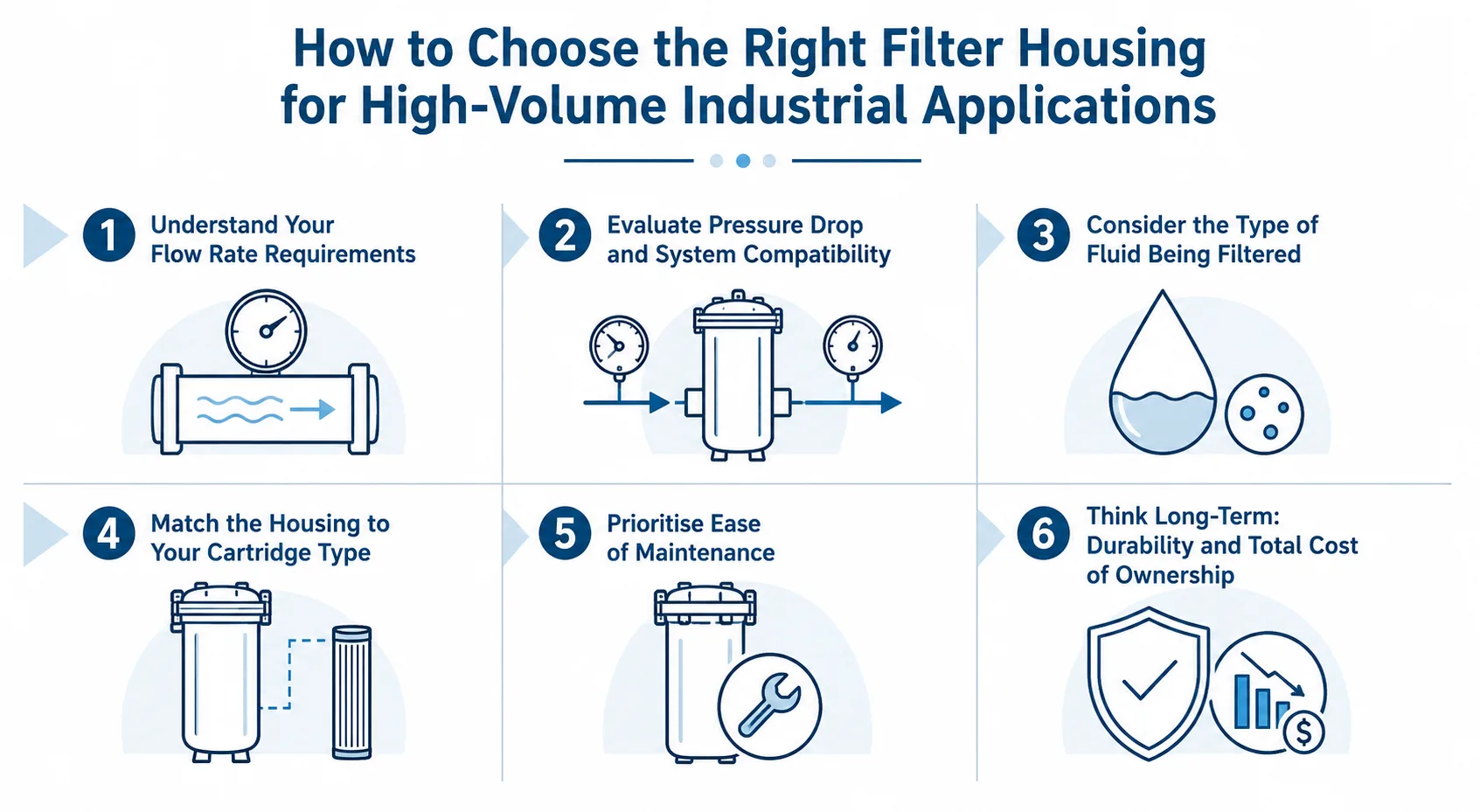
1. Understand Your Flow Rate Requirements
Flow rate is one of the most important factors when selecting a filter housing. It determines how much liquid must pass through the system within a specific period.
When evaluating flow requirements, consider the following:
- Standard housings suit low to moderate flow rates but are inadequate for industrial-scale operations such as water treatment or chemical processing.
- High-volume applications require housings engineered specifically for large throughputs without compromising filtration efficiency.
- Always account for both average and peak flow rates, a housing that performs well under normal conditions may fail during production surges.
- Consistent performance at high flow prevents bypass and uneven distribution across the filter media, which can reduce filtration quality.
2. Evaluate Pressure Drop and System Compatibility
Pressure drop refers to the reduction in pressure that occurs as liquid passes through the filtration system. It is a key performance indicator because excessive pressure drop can increase energy consumption, place additional strain on pumps, and shorten the lifespan of connected equipment.
When assessing filter housings, ensure the pressure rating is compatible with your existing system and operating conditions. A well-designed housing should maintain a low pressure drop even under peak flow rates.
It is also important to evaluate inlet and outlet configurations, as these influence how smoothly fluid moves through the system. Proper compatibility between the housing and the overall filtration setup helps maximise efficiency while reducing operating costs.
3. Consider the Type of Fluid Being Filtered
The characteristics of the fluid being processed play a major role in determining the most suitable filter housing material. Factors such as chemical composition, temperature, viscosity, and pH level should all be carefully evaluated.
For demanding industrial applications, material compatibility is especially important:
- Stainless steel housings provide excellent resistance to corrosion, high temperatures, and aggressive chemicals, making them a popular choice for industrial environments.
- Polypropylene and PVDF housings may be more suitable for applications where chemical resistance is required or where metal contact must be avoided.
- Always verify material compatibility with the specific fluid before making a final selection.
4. Match the Housing to Your Cartridge Type
Filter housings are designed to accommodate specific cartridge configurations. Selecting the correct housing for your cartridge type is essential for achieving optimal filtration performance and controlling operating costs.
High-flow applications often utilise larger diameter cartridges because they provide greater filtration surface area. This allows for higher flow rates while reducing the frequency of cartridge replacement.
Multi-cartridge housings are another effective solution for applications with substantial flow demands. By distributing liquid evenly across multiple cartridges, these systems improve reliability, extend cartridge service life, and minimise maintenance interruptions.
5. Prioritise Ease of Maintenance
In high-volume industrial operations, maintenance efficiency can significantly affect productivity. The easier a filter housing is to service, the less downtime your operation will experience.
Consider features such as:
- Top-entry designs that allow cartridge replacement without disconnecting pipework.
- Swing bolt closures that enable quick access without specialised tools.
- Sight glasses that allow operators to visually inspect filter conditions.
- Differential pressure indicators that signal when cartridge replacement is required.
6. Think Long-Term: Durability and Total Cost of Ownership
The purchase price of a filter housing represents only a portion of the overall investment. Long-term operating costs should also be considered, including maintenance labour, cartridge replacement frequency, energy consumption, and potential downtime.
A higher-quality filter housing may have a greater initial cost, but it often delivers significant savings over its service life through improved reliability and lower maintenance requirements. For example, industrial-grade stainless steel housings can often provide 10 to 20 years of dependable service under demanding conditions. Investing in a durable solution from a reputable manufacturer can help minimise unexpected failures and reduce total ownership costs over time.
7. Work with an Experienced Manufacturer
Selecting the right filter housing involves more than choosing a vessel that fits your flow rate. Factors such as fluid characteristics, operating pressure, cartridge configuration, material compatibility, and maintenance requirements all play a role in determining long-term filtration performance.
Working with an experienced filtration solutions provider such as Recalyx can help simplify the selection process. With extensive expertise in industrial filtration systems, Recalyx manufactures a wide range of stainless steel filter housings, high-flow filtration systems, and customised solutions designed to meet specific application requirements. Whether you operate in water treatment, chemical processing, food and beverage manufacturing, or other industrial sectors, the right technical guidance can help improve system efficiency, reliability, and overall operating costs.
Quick Reference Summary
Use the table below to quickly review the key factors when selecting a filter housing for high-volume industrial use:
| Factor | What to Check |
Why It Matters |
| Flow Rate | Volume per hour/minute; peak vs average | Ensures housing handles demand without bypass |
| Pressure Drop | Housing pressure rating vs system pressure | Prevents pump strain and energy waste |
| Fluid Type | Chemical composition, pH, temperature | Determines compatible housing material |
| Cartridge Type | Size, diameter, single vs multi-cartridge | Affects filtration surface area and change frequency |
| Maintenance | Access design, closure type, indicators | Reduces downtime during cartridge replacement |
| Durability / TCO | Material grade, service life, warranty | Lowers total cost of ownership over time |
| Manufacturer Support | Customisation options, technical expertise | Ensures solution fits your exact process needs |
Conclusion
Choosing the right filter housing for high-volume industrial applications is an important investment that directly impacts operational efficiency, product quality, and maintenance costs. By carefully evaluating flow rate requirements, pressure conditions, fluid compatibility, cartridge configurations, maintenance accessibility, and long-term durability, you can select a filtration solution that delivers reliable performance for years to come.
As a Malaysian manufacturer specialising in industrial filtration systems, Recalyx provides high-flow cartridge filter housings, stainless steel filter housings, and customised filtration solutions engineered for demanding industrial environments. Backed by decades of filtration expertise, our team can help you identify the most suitable system based on your process requirements and operating conditions.
Contact Recalyx today to discuss your filtration requirements and discover a solution designed for long-term performance and efficiency.
FAQs
What is a filter housing and why is it important in industrial filtration?
A filter housing is a vessel that holds filter cartridges or filter bags and directs fluid through the filtration media. It plays a critical role in protecting equipment, maintaining product quality, and ensuring efficient filtration performance in industrial processes.
How do I choose the right filter housing for high-volume applications?
The right filter housing should be selected based on flow rate, operating pressure, fluid characteristics, cartridge configuration, material compatibility, and maintenance requirements. High-volume applications typically require housings designed to handle large flow rates while maintaining low pressure drop and consistent filtration efficiency.
Why is flow rate important when selecting a filter housing?
Flow rate determines the volume of liquid that must pass through the filtration system. Choosing a housing that cannot accommodate your required flow rate may result in excessive pressure drop, reduced filtration efficiency, and increased maintenance frequency.
What material is best for industrial filter housings?
Stainless steel is one of the most commonly used materials for industrial filter housings due to its durability, corrosion resistance, and ability to withstand high temperatures and pressures. The ideal material depends on the fluid being filtered and the operating environment.
How does pressure drop affect filtration system performance?
Excessive pressure drop can increase pump workload, raise energy consumption, and reduce overall system efficiency. Selecting a properly sized filter housing helps maintain stable flow and minimises operational costs.